Instant Payouts for iGaming: Push-to-Card Explained
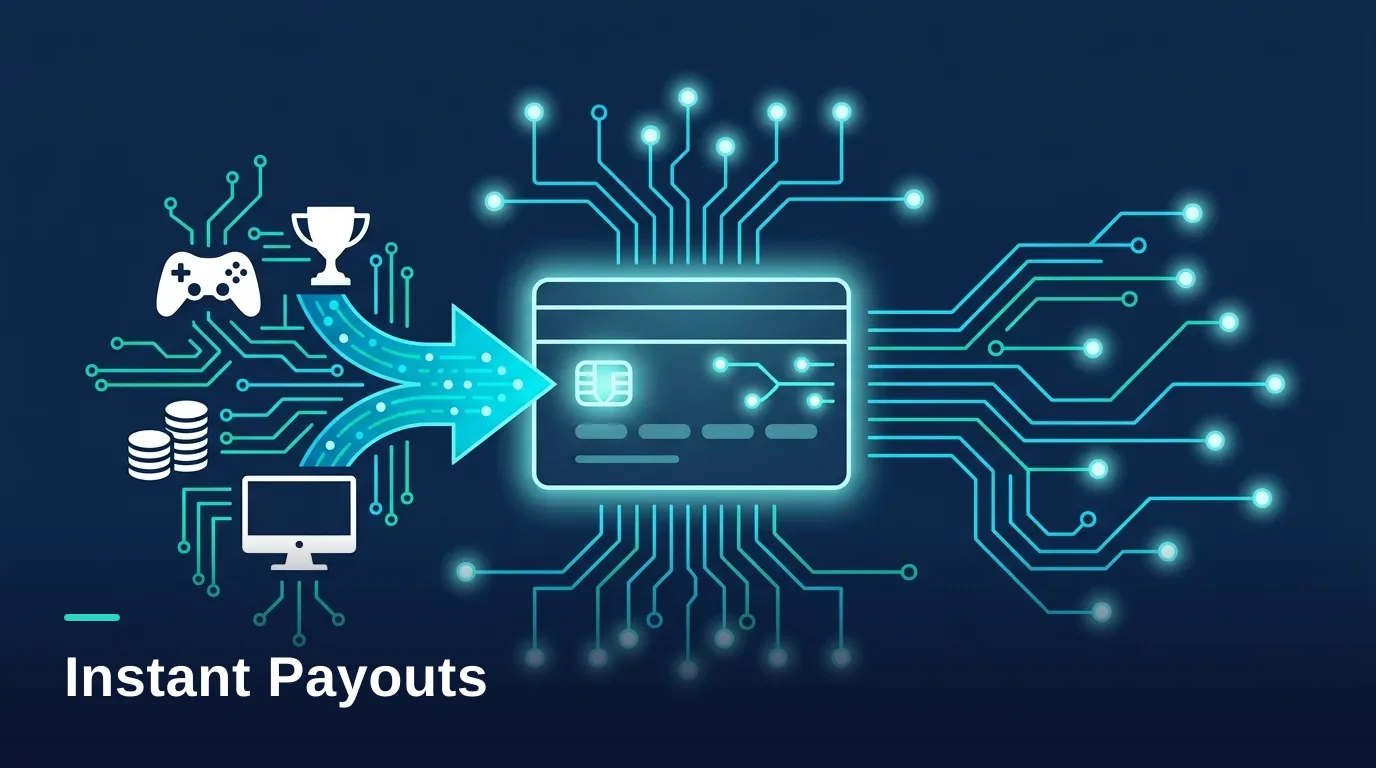
Ask a player what they care about and payout speed comes back ahead of bonuses, odds and game choice. When Paysafe surveyed bettors for its research on payments, quick and easy payouts topped the list. That single preference is why instant payouts have become a competitive weapon rather than a nice-to-have.
The technology behind most of them is push-to-card: the same card rails that carry a deposit, run in reverse to send winnings straight to a player's debit card in minutes.
This guide explains how instant card payouts actually work, what Visa Direct and Mastercard Send are, why the 30-minute rule doesn't always hold, and where push-to-card fits against bank transfers and e-wallets. Facts verified as of August 2026.
What are instant payouts in iGaming?
Instant payouts are withdrawals that reach a player within minutes of approval, rather than the one to five days a bank transfer takes. In practice the phrase almost always means push-to-card: sending funds to a player's Visa or Mastercard debit card over the card networks.
Term: instant payout. Definition: A gambling withdrawal delivered to the player's payment card in near real time using a card-network credit transaction, instead of a slower bank or wire transfer.
The distinction matters because "instant" is used loosely. Some operators call a payout instant when they approve it instantly but the money still crawls through a bank file overnight. A genuine instant payout is one where the settlement rail itself is fast, and push-to-card is the most widely available fast rail for card holders.
How does push-to-card work?
Push-to-card works by sending an Original Credit Transaction, or OCT, to the player's card. The OCT is the mirror image of a normal purchase: instead of pulling money from the card, it pushes money onto it, crediting the account behind the card.
Term: Original Credit Transaction (OCT). Definition: A card-network transaction that credits funds to a cardholder's account, used to push payouts, refunds and disbursements to a debit or prepaid card.
A deposit is a debit against the card. A withdrawal by push-to-card is a credit to it. Because the operator sends the money rather than requesting it, the player only has to give a card number they already used to deposit. No new bank details, no account linking, no wallet registration. That low friction is a large part of why the first withdrawal experience holds players who might otherwise drift.
What is Visa Direct?
Visa Direct is Visa's push-payments platform, built on the OCT, that lets a business send funds in near real time to an eligible debit or reloadable prepaid card. For iGaming it's the rail that turns an approved withdrawal into money the player can spend within minutes.
Visa layers a service called Fast Funds on top. Participating issuers commit to making pushed funds available to the recipient within a maximum of 30 minutes of approving the OCT. Many transactions land far quicker than that, sometimes in seconds. The rules and reach are set out in Visa's Visa Direct documentation and the developer OCT reference.
The catch is that not every issuer participates in Fast Funds. Where the player's bank isn't enrolled, the same OCT can take up to two business days to post. The payout is still push-to-card, but the "instant" promise depends on the receiving bank, not the operator.
What is Mastercard Send?
Mastercard Send is Mastercard's equivalent push-payments platform, moving funds to eligible cards in near real time through the MoneySend transaction set. It does the same job as Visa Direct on the Mastercard network.
There's a gambling-specific wrinkle. Standard MoneySend is not permitted for gambling payouts. Operators have to run those through Mastercard's Gaming and Gambling Payments Program, which sets its own registration, licensing and monitoring standards. So a Mastercard push-to-card payout to a player is not the same product as a MoneySend transfer between friends, even though the underlying rail looks similar. Details sit on Mastercard's Mastercard Send pages.
The practical takeaway: your acquirer or PSP has to be enrolled in the right programme on each network before you can offer card payouts at all. This isn't something you switch on unilaterally.
How fast are instant payouts, really?
Fast where the receiving issuer supports it, slow where it doesn't. Visa's 30-minute Fast Funds ceiling and Mastercard's near-real-time equivalent apply only to enrolled issuers, and coverage varies by country and by bank.
In my experience the honest way to describe a card payout to players is "usually within minutes, sometimes up to two business days" rather than a flat "instant". Over-promising here is a support-ticket generator. The player who was told instant and waited a day feels misled, even though the delay sat with their own bank.
Coverage is also uneven by market. Push-to-card is mature in the UK and much of Europe and the US, thinner in some emerging markets where local rails like Pix in Brazil or Interac in Canada do the fast-payout job instead. There's no single global instant rail, which is why serious operators run several.
Push-to-card vs bank transfer vs e-wallet: which is fastest?
Push-to-card and e-wallets are both near-instant for the player; bank transfers are the slow option. The right choice depends on which method the player used to deposit and which markets you serve.
- Push-to-card (Visa Direct / Mastercard Send): minutes for enrolled issuers, up to two business days otherwise. No new details needed if the player deposited by card.
- E-wallet (PayPal, Skrill, Neteller): near-instant into the wallet, but the player then has to move it to a bank. Requires the player to hold and fund a wallet.
- Open banking / bank transfer: open banking payouts can settle in seconds on instant rails; legacy bank transfers take one to five days.
A payout OCT is a credit, not a purchase, so it doesn't create a transaction a cardholder can dispute. That removes one whole category of chargeback risk that deposit flows carry. It does not remove the operator's obligation to run the withdrawal through KYC and AML checks first, and it doesn't stop fraudsters trying to cash out to a card that isn't theirs.
What does push-to-card cost operators?
Each OCT carries a per-transaction cost that sits above a plain bank transfer, plus the scheme and programme fees for being enrolled. Exact pricing is set by your acquirer or payout provider and varies by region and volume, so treat any single quoted rate with caution.
The economics still tend to favour card payouts once you count retention. A player paid in minutes is more likely to come back and redeposit than one who waited days, and that lifetime value usually dwarfs the few cents of difference per transaction. You can put real numbers behind that trade-off with our payments calculator before your next provider negotiation.
Limits are the other constraint. Networks and providers cap the value and velocity of push-to-card transactions, so very large withdrawals may still need a bank transfer. Build that split into your payout routing rather than forcing everything down one rail.
How do operators offer instant payouts?
Through an acquirer or payout provider that's enrolled in Visa Direct and Mastercard's gaming programme, usually sitting behind an orchestration layer that picks the right rail per withdrawal. Few operators integrate the networks directly.
The build order that works: enable card payouts for the markets where issuer coverage is strong, fall back to open banking or local rails where it isn't, and keep bank transfer for amounts above the push-to-card limit. The iGamingPayments.ai directory lists PSPs and payout providers by region and method, including which ones genuinely support instant card payouts for gambling rather than deposits alone. The payments glossary defines the surrounding terms if any of this is new.
Key Takeaways
- Instant iGaming payouts almost always mean push-to-card: sending winnings to a player's debit card over the card networks
- The mechanism is the Original Credit Transaction (OCT), the reverse of a deposit - it credits the card instead of debiting it
- Visa Direct with Fast Funds targets funds within 30 minutes, but only for enrolled issuers; others can take up to two business days
- Mastercard Send uses MoneySend, but gambling payouts must run through Mastercard's Gaming and Gambling Payments Program, not standard MoneySend
- A payout OCT is a credit, so it can't be charged back - but KYC, AML and fraud checks still apply before you pay
- No single rail covers every market; pair card payouts with open banking and local rails, routed by an orchestration layer
Frequently asked questions
Can I offer instant payouts to a player's credit card?
Usually not. Push-to-card is built for debit and reloadable prepaid cards, and credit card payout eligibility is limited and inconsistent across issuers. Many markets also restrict gambling on credit entirely, so debit is the practical route for instant card payouts.
What happens if the player's bank isn't on Fast Funds?
The payout still goes through as an OCT, but instead of landing within 30 minutes it can take up to two business days to post. The operator has done everything right; the delay sits with the receiving issuer. This is why describing card payouts as flatly "instant" causes support complaints.
Is a push-to-card payout safe from chargebacks?
The payout itself is. An OCT is a credit to the card, not a purchase, so there's no transaction the cardholder can dispute back to you. That said, it doesn't protect against paying out to a stolen or mismatched card, which is why identity and card-ownership checks come before the payout, not after.
Is push-to-card the same as Visa Direct?
Push-to-card is the general technique of crediting a card with an OCT. Visa Direct is Visa's branded platform for doing it, and Mastercard Send is Mastercard's. So Visa Direct is one way to run push-to-card, not a synonym for it.
Why can't I just use standard Mastercard Send for payouts?
Because Mastercard excludes gambling from standard MoneySend. Gambling payouts have to run through Mastercard's Gaming and Gambling Payments Program, which carries its own registration, licensing and monitoring requirements. Your acquirer or PSP has to be enrolled in that programme before you can send card payouts on the Mastercard network.
How much does an instant card payout cost compared with a bank transfer?
More per transaction, as a rule, because you pay a per-OCT cost plus scheme and programme fees. Exact pricing depends on your provider, region and volume. The retention gain from paying players in minutes usually outweighs the difference, but model it for your own numbers rather than assuming.
Do instant card payouts work in every country?
No. Issuer coverage for push-to-card is strong in the UK, Europe and the US and patchier elsewhere. In markets like Brazil and Canada, fast local rails such as Pix and Interac often do the instant-payout job instead. Running more than one payout rail is the only way to cover a global player base.
Find the right payment provider for your operation
Browse 342+ vetted PSPs, crypto processors, open banking providers and fraud vendors - filtered by region, vertical and payment method. Or run the numbers before your next PSP negotiation.