Payment Gateway vs PSP vs Acquirer for iGaming Explained
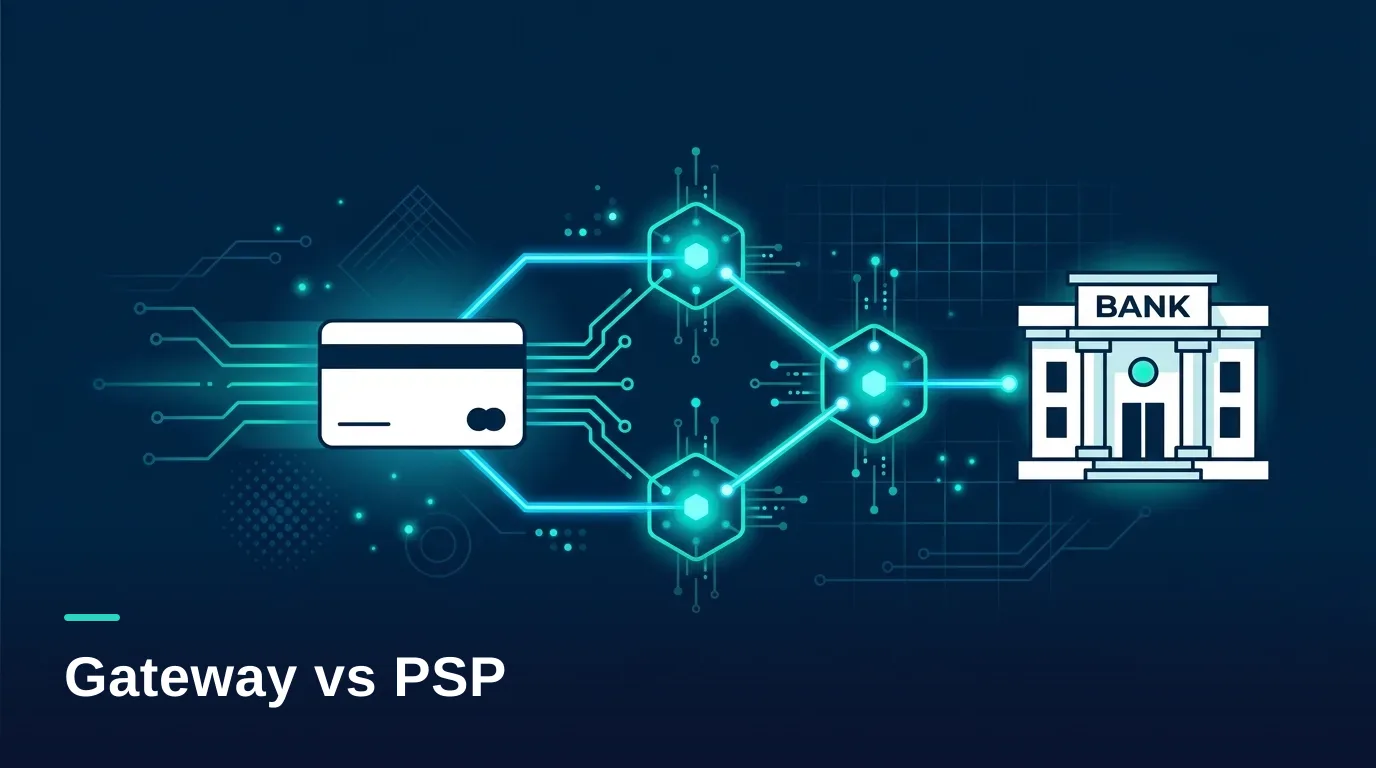
Three words get used as if they mean the same thing: payment gateway, PSP and acquirer. They don't. Each does a different job, sits at a different point in the card flow, and carries a different kind of risk for a gambling operator.
The payment gateway vs PSP question trips up most operators because a single vendor often sells you all three at once, wrapped in one contract, so the roles blur. When approval rates drop or an account gets pulled, knowing which layer failed is the difference between a quick fix and a month of finger-pointing.
This guide separates the three, shows how they connect, and explains why for iGaming the acquirer is the piece that decides whether you trade at all. Facts verified as of August 2026.
Term: card payment stack. Definition: The chain that carries a card deposit from the player to the operator's bank account, made up of a gateway (the connection), a PSP (the service layer) and an acquirer (the licensed bank that settles the money).
What is a payment gateway?
A payment gateway is the software that captures a player's card details at the checkout and passes them securely to the rest of the payment chain. It's the connection, not the money mover.
The gateway encrypts or tokenises the card data, sends the authorisation request onward, and returns the approve-or-decline answer to your cashier page. It handles the technical handshake and nothing else. On its own, a gateway never touches your settled funds and holds no licence to move them.
Think of it as the plug. A good gateway gives you clean hosted fields, keeps card data out of your servers to shrink your PCI DSS scope, and supports the authentication step for 3D Secure and Strong Customer Authentication. What it can't do is decide whether your business is allowed to accept gambling money in the first place.
What is a PSP (payment service provider)?
A payment service provider is the company that sits between you and the banking system and delivers payments as a managed service. It usually bundles a gateway, connections to acquirers, reporting, reconciliation, fraud tools and support into one relationship.
Term: payment service provider (PSP). Definition: A regulated firm that provides payment services to merchants, typically combining the gateway, acquiring connections and value-added services under one contract. In the EU and UK, the licensed categories that sit behind this are set out in the second Payment Services Directive.
Under PSD2 (Directive (EU) 2015/2366), "acquiring of payment transactions" and "issuing of payment instruments" are named payment services in Annex I, and a firm needs authorisation to provide them. So "PSP" is a commercial label, not a single licence. Some PSPs hold acquiring permissions themselves. Many don't, and instead front for a separate acquiring bank while handling everything the operator sees day to day.
That distinction matters more in gambling than anywhere else. A PSP that resells someone else's acquiring licence can lose that relationship overnight, and your payments go with it.
What is an acquiring bank?
An acquiring bank, or acquirer, is the licensed institution that holds the merchant account, receives card transactions on the operator's behalf, and settles the money into the operator's account. It's the party that actually carries the financial and regulatory risk.
The FCA's Payment Services and Electronic Money approach document defines acquiring as contracting with a payee to accept and process payment transactions that result in a transfer of funds to that payee. In the four-party card model, the acquirer sits opposite the issuer, with Visa or Mastercard as the network in between.
The acquirer is where gambling risk lives. It's the acquirer that registers your business with the schemes, assigns your MCC 7995 gambling code, sets your rolling reserve, and takes the hit if your chargebacks blow through scheme thresholds. When people say gambling is a high-risk merchant account, the risk they mean is the acquirer's.
Payment gateway vs PSP: what's the difference?
A payment gateway is one component; a PSP is the packaged service that usually contains a gateway plus much more. Buying a bare gateway means wiring the rest of the stack yourself; buying a PSP means most of it comes pre-connected.
Put simply: every PSP offers gateway functionality, but not every gateway is a PSP. A standalone gateway sends the message. A PSP sends the message, manages the acquiring relationships behind it, reconciles the settlement, and gives you one dashboard and one support line for the lot.
For a small operator launching in one market, a full PSP removes work. For a larger operator running several markets, splitting the gateway from the acquiring, often through a payment orchestration layer, buys the freedom to switch acquirers without ripping out the checkout.
PSP vs acquirer: what's the difference?
A PSP provides the service and the technology; an acquirer holds the licence and settles the funds. A PSP can exist without its own acquiring permissions, but it can't settle a card payment without an acquirer somewhere behind it.
The confusion comes from bundling. When your PSP is also a licensed acquirer, one company plays both roles and you never see the seam. When your PSP is not an acquirer, it's contracting with one or more banks on your behalf, and the strength of those bank relationships decides how stable your payments are.
Ask the direct question before you sign: is this provider the acquirer of record, or is it introducing me to one? In gambling the answer changes your risk profile completely. If the acquirer drops the portfolio, a reselling PSP has to find you a new home, and that can mean days offline and a fresh round of underwriting.
Do iGaming operators need a gateway, a PSP and an acquirer?
Yes. Every card deposit needs all three functions, whether they come from one vendor or several. The only real choice is how many contracts sit between you and the money.
You can buy a single PSP that bundles gateway and acquiring, and many operators start there. Or you can run an independent gateway or orchestration layer on top of multiple acquirers, which is how most scaled operators end up once one acquirer stops being enough. The functions are fixed; the packaging is negotiable.
The trade-off is control versus simplicity. One bundled provider is easier to launch and harder to leave. A split stack is more work to build and far more resilient when a single acquirer decides gambling is no longer worth its risk appetite.
Why is the acquirer the hardest part for iGaming?
Because the acquirer carries the regulatory and financial exposure, and gambling is one of the few categories the card schemes police as high-integrity-risk. Gateways and PSPs are relatively easy to find. A stable gambling acquirer in your target market is not.
Card issuers can decline a legitimate deposit purely on the gambling MCC, and in Great Britain credit card gambling is banned outright since April 2020. The acquirer absorbs the chargeback risk, the scheme monitoring and the reserve exposure that comes with all of it. That's why acquirers underwrite gambling hard, price it above standard e-commerce, and pull portfolios when the numbers turn.
It's also why local acquiring matters so much. A domestic acquirer in a licensed market lifts approval rates that a cross-border one can't touch. You can model what that uplift is worth to your revenue with our approval rate calculator before your next negotiation.
How should an operator choose the right setup?
Start with the acquirer, because that's the constraint. Then pick the gateway or PSP that connects you to the acquirers you actually need, in the markets you actually serve.
- Confirm who the acquirer of record is. If your PSP resells someone else's licence, know whose, and what happens if that relationship ends.
- Match the acquirer to your markets. Local acquiring in each licensed market beats one cross-border bank trying to cover everything.
- Keep the gateway portable. A gateway or orchestration layer that isn't locked to one acquirer lets you add or swap banks without rebuilding checkout.
- Read the reserve and pricing terms as acquirer terms. The rolling reserve, the chargeback fees and the settlement delay are set by the acquirer, not the friendly PSP dashboard.
- Don't run on a single acquirer at scale. One bank's risk decision shouldn't be able to take your whole deposit flow offline.
Most of this comes down to provider selection. The iGamingPayments.ai directory lists gateways, PSPs and acquirers by region and vertical, and flags which providers genuinely acquire gambling traffic rather than resell it. The payments glossary defines the surrounding terms if a word here is new.
Key Takeaways
- A gateway is the connection, a PSP is the packaged service, an acquirer is the licensed bank that settles the money
- Every PSP offers gateway functionality, but not every gateway is a PSP, and not every PSP holds its own acquiring licence
- Under PSD2, acquiring and issuing are named, licensed payment services; "PSP" is a commercial label, not a single licence
- The acquirer carries the gambling risk: it assigns MCC 7995, sets the rolling reserve and owns the scheme relationship
- Every card deposit needs all three functions; the choice is how many contracts and how much control you keep
- Confirm who the acquirer of record is, acquire locally, and never let a single acquirer be able to take you offline
Frequently asked questions
Is a payment gateway the same as a PSP?
No. A payment gateway is one component - the software that captures and transmits card data. A PSP is the broader service that usually includes a gateway plus acquiring connections, reconciliation, fraud tools and support. Every PSP provides gateway functionality, but a standalone gateway is not a full PSP.
Can a PSP also be the acquirer?
Yes, some PSPs hold their own acquiring licence and act as both. Others front for a separate acquiring bank and handle only the service and technology layer. The difference matters in gambling: if your PSP resells someone else's acquiring, that relationship can end and take your payments with it.
Do I need all three for an iGaming site?
Yes, every card deposit needs the gateway, PSP and acquirer functions to complete. They can come from a single bundled provider or from separate vendors stitched together. The functions are fixed; only the packaging and the number of contracts change.
Why do gambling operators struggle to find an acquirer?
Because the acquirer carries the regulatory and chargeback risk, and the card schemes classify gambling as high-integrity-risk. Acquirers underwrite it strictly, hold reserves, price it above standard e-commerce, and can exit the category when the numbers turn. Gateways and PSPs are easier to source than a stable gambling acquirer in a specific market.
What is the difference between an acquirer and an issuer?
The acquirer is the merchant's bank; the issuer is the cardholder's bank. In the four-party card model the acquirer accepts and settles the transaction for the operator, while the issuer authorises or declines it for the player. Visa or Mastercard sit between them as the network.
Is it safer to use one bundled provider or split the stack?
It depends on scale. One bundled provider is simpler to launch and manage but harder to leave, and a single acquirer decision can take you offline. Splitting the gateway from multiple acquirers, often through an orchestration layer, is more work to build but far more resilient for operators running several markets.
Find the right payment provider for your operation
Browse 342+ vetted PSPs, crypto processors, open banking providers and fraud vendors - filtered by region, vertical and payment method. Or run the numbers before your next PSP negotiation.