iGaming Payments in the US: Methods and State Rules
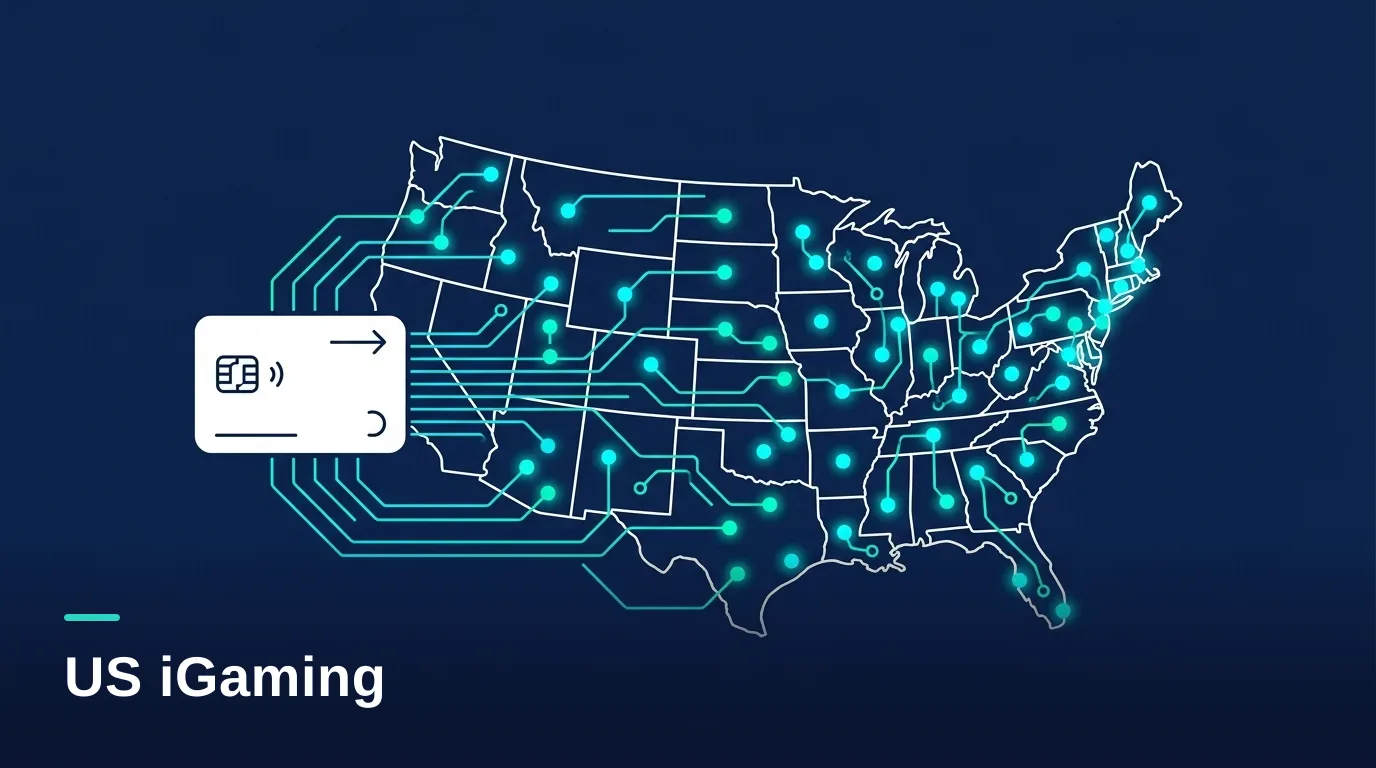
iGaming payments in the US work state by state, not nationwide. Online casino is legal in only a handful of states, every one runs its own regulator, and the card system treats a legal US deposit and an offshore one with the same suspicion until you prove otherwise.
That is the whole problem in one sentence. An operator can hold a valid New Jersey licence, geofence its players inside state lines, and still watch a large share of card deposits fail because the issuing bank blocks anything that looks like gambling.
This guide covers which states allow online casino, why the payment rails are so cautious, and the methods US players actually use to fund an account. Facts verified as of September 2026.
Which US states allow online casino payments?
As of September 2026, eight states have legalised real-money online casino: New Jersey, Delaware, Pennsylvania, Michigan, West Virginia, Connecticut, Rhode Island and Maine. Payments for licensed online casino are only lawful for players physically inside one of those states.
Term: iGaming (US). Definition: Real-money online casino and poker offered by state-licensed operators, distinct from online sports betting, which is legal in far more states.
Delaware and New Jersey launched first, back in 2013. Pennsylvania, West Virginia, Michigan, Connecticut and Rhode Island followed between 2019 and 2024. Maine legalised online casino in early 2026 through a tribal model, but as of this writing it hasn't gone live and no operator applications have been approved.
Everywhere else, real-money online casino is unlicensed. That single fact drives the whole payments picture, because the card networks and banks have to tell a legal Michigan deposit apart from an illegal one in a state next door.
Why are US gambling payments regulated state by state?
There is no federal online gambling licence. Each state that allows iGaming writes its own rules and runs its own regulator, so a national operator holds a separate licence, and often a separate payments setup, in every state it enters.
The New Jersey Division of Gaming Enforcement, the Michigan Gaming Control Board and the Pennsylvania Gaming Control Board each set their own account, geolocation and payment requirements. Nothing about one licence carries over to the next.
For payments, this means geolocation is not optional. Every deposit and bet has to be checked against the player's real-time location, because taking a wager from someone who has stepped over a state line turns a legal transaction into an unlawful one. That check sits upstream of the payment, and the payment fails if it fails.
What is UIGEA and how does it affect payments?
The Unlawful Internet Gambling Enforcement Act of 2006 (UIGEA) makes it illegal to knowingly accept payments connected to unlawful online gambling. It doesn't ban gambling itself - it puts the block on the payment.
Term: UIGEA. Definition: A 2006 federal law, implemented through the Federal Reserve and Treasury's Regulation GG, that requires banks and card networks to identify and block "restricted transactions" tied to unlawful internet gambling.
Under Regulation GG, payment-system participants have to build policies that block restricted transactions, and the card networks carry most of the coding burden. The law is nearly twenty years old, but its fingerprints are all over why deposits fail today.
Here's the part that catches operators out: UIGEA predates every legal iGaming market. Banks spent years treating all coded gambling as suspect, and a lot of those blanket policies never got rewritten once states started licensing. The law targets unlawful gambling; the enforcement, in practice, often catches the legal kind too.
Why do card deposits get declined at US casinos?
Card deposits fail at licensed US casinos because the issuing bank blocks the transaction category, not the specific merchant. The operator is legal, the deposit is legal, and the player's own bank still says no.
Three things stack up here. Issuers with old anti-gambling policies decline the category outright. Credit cards get treated as quasi-cash, so the deposit carries a cash advance fee and interest from day one, and many players' cards refuse it. And cross-border or unfamiliar processing paths score worse in the bank's risk model.
Independent processor estimates in 2026 put card decline rates on generic gambling coding at 30-40%, against 5-10% for mainstream e-commerce. Treat that as a range, not gospel, but the direction is real: gambling cards fail several times more often than retail. Debit generally clears more reliably than credit, which is why most US operators push debit and bank-based methods first.
This is the same approval-rate problem operators face everywhere, just sharpened by US bank conservatism. Our guide to approval rates for iGaming payments covers how to measure and move that number.
What payment methods do US iGaming players use?
Because cards are unreliable, US iGaming leans hard on bank-linked and prepaid methods built specifically for regulated gambling. The dominant names are VIP Preferred, Play+ and PayNearMe, alongside plain ACH and, in some states, PayPal.
- VIP Preferred. A bank-linked ACH e-check service that stores verified bank details in the cashier for fast repeat deposits. Widely accepted, high limits, and popular because it bypasses card issuers entirely.
- Play+. A prepaid, reloadable account run by Sightline Payments. The player loads it from a bank or card, then spends it at the operator - useful because the gambling charge never reaches the funding bank as a gambling charge.
- PayNearMe. Cash deposits at retailers including 7-Eleven, CVS and Family Dollar. It covers the unbanked and card-declined, but it's deposit-only, so payouts run through another method.
- ACH and online banking. Direct bank transfer, cheap and reliable, though slower to settle than the wallet products above.
- PayPal. Available with some operators in some states, and trusted by players, but its own gambling rules vary by market.
The pattern is clear once you see it: the methods that win in the US are the ones that don't route a gambling transaction through a card issuer. That's not a coincidence, it's the market working around the decline problem.
How do MCC codes affect US gambling card approval?
Card transactions carry a merchant category code (MCC) that tells the bank what kind of business sent them. Gambling normally codes as 7995, which many US issuers decline by default - but state-regulated operators can use better codes.
The card networks created US-specific codes - 7800 for government lotteries, 7801 for government-licensed online casinos and sports betting, and 7802 for licensed racing - so issuers can approve legal state gambling without opening the door to offshore 7995 traffic. A New Jersey casino running on 7801 gets materially better treatment than the same deposit on generic 7995.
The definitions sit in Visa's Merchant Data Standards Manual. If you run in a licensed US market and your deposits are still going out under 7995, that's a fix to raise with your acquirer now. Our full guide to MCC 7995 and gambling coding walks through how the codes behave.
US iGaming vs US sports betting payments: what's the difference?
The payment methods are largely the same, but the map is not. Online sports betting is legal in far more states than online casino, so a sportsbook's payments reach a much wider footprint than an iGaming operator's.
Both use VIP Preferred, Play+, PayNearMe and ACH, and both hit the same card-decline wall. The difference is scale and reach: an operator running casino and sportsbook side by side often finds the casino product live in a handful of states while the sportsbook runs in dozens.
My view, after watching these launches: operators underestimate how much of the payments work is per-state plumbing rather than product. Each new state means fresh geolocation rules, sometimes a fresh acquirer relationship, and a fresh round of proving legality to banks that would rather not bother.
How do US operators improve deposit approval rates?
The levers are the same as anywhere, applied to a stricter market: code transactions correctly, offer the methods that dodge card issuers, and route across more than one processor.
- Use the licensed-market MCC. Get onto 7801 where you qualify, not generic 7995.
- Lead with bank and prepaid methods. VIP Preferred, Play+ and ACH avoid the issuer block that kills card deposits.
- Push debit ahead of credit. Debit clears more often and skips the cash advance problem entirely.
- Route across multiple processors. Issuer behaviour varies by acquirer path, so a retry down a second route recovers deposits a single provider loses.
- Get onboarding and KYC right up front. Clean identity and location checks reduce the friction that banks read as risk - see our guide to KYC and AML for iGaming payments.
Provider choice does most of the work. The iGamingPayments.ai directory lists PSPs and processors by region and vertical, including which ones genuinely handle US regulated gambling, and the payments glossary defines the terms around it. You can also model what an approval-rate gain is worth to your revenue with our payment cost calculator.
Key Takeaways
- Online casino is legal in eight US states as of September 2026 - New Jersey, Delaware, Pennsylvania, Michigan, West Virginia, Connecticut, Rhode Island and Maine (Maine not yet live)
- There is no federal iGaming licence; every state runs its own regulator, so payments are set up state by state
- UIGEA 2006 and Regulation GG push banks to block gambling-coded transactions, and many blanket policies predate legal markets
- Card deposits fail far more often than retail; bank-linked and prepaid methods like VIP Preferred, Play+ and ACH are the workaround
- Licensed US operators should run on MCC 7801, not generic 7995, for materially better issuer approval
Frequently asked questions
Is online gambling legal in the US?
Partly. There is no nationwide legalisation. Online casino is legal in eight states as of September 2026, online sports betting is legal in many more, and online poker in a smaller set. Everywhere else, real-money online casino is unlicensed, and payments to unlicensed operators fall under UIGEA.
Why did my deposit get declined at a licensed US casino?
Almost always because your own bank blocks gambling transactions by category, not because the casino did anything wrong. Credit cards are the most likely to fail, since many issuers treat gambling as quasi-cash or decline it outright. Debit, VIP Preferred, Play+ or ACH usually go through where a credit card won't.
Can I use a credit card to gamble online in the US?
Sometimes, but it's the least reliable option. Many issuers decline gambling MCCs on credit cards, and those that allow them often charge a cash advance fee plus interest from the transaction date. Debit and bank-based methods are cheaper and clear more often.
What is the safest way to deposit at a US online casino?
Bank-linked methods built for regulated gambling - VIP Preferred, ACH and Play+ - are the most reliable at licensed operators. They route around card issuers, carry no cash advance charges, and are only offered inside states where the operator is licensed.
Does an operator need a separate licence in every state?
Yes. There is no federal online gambling licence, so an operator applies to each state regulator separately and meets that state's own account, geolocation and payment rules. Payments infrastructure often has to be reconfigured for each new market.
What MCC should a licensed US iGaming operator use?
MCC 7801, the code for government-licensed online casinos and sports betting, rather than generic gambling code 7995. Issuers treat 7801 far more favourably because it signals state-regulated activity. Running licensed US volume on 7995 leaves approval rates on the table.
Can US players withdraw winnings the same way they deposit?
Usually, with one common exception: cash-in methods like PayNearMe are deposit-only, so payouts run through ACH, a bank transfer or a wallet product instead. VIP Preferred and Play+ support both directions.
Find the right payment provider for your operation
Browse 342+ vetted PSPs, crypto processors, open banking providers and fraud vendors - filtered by region, vertical and payment method. Or run the numbers before your next PSP negotiation.